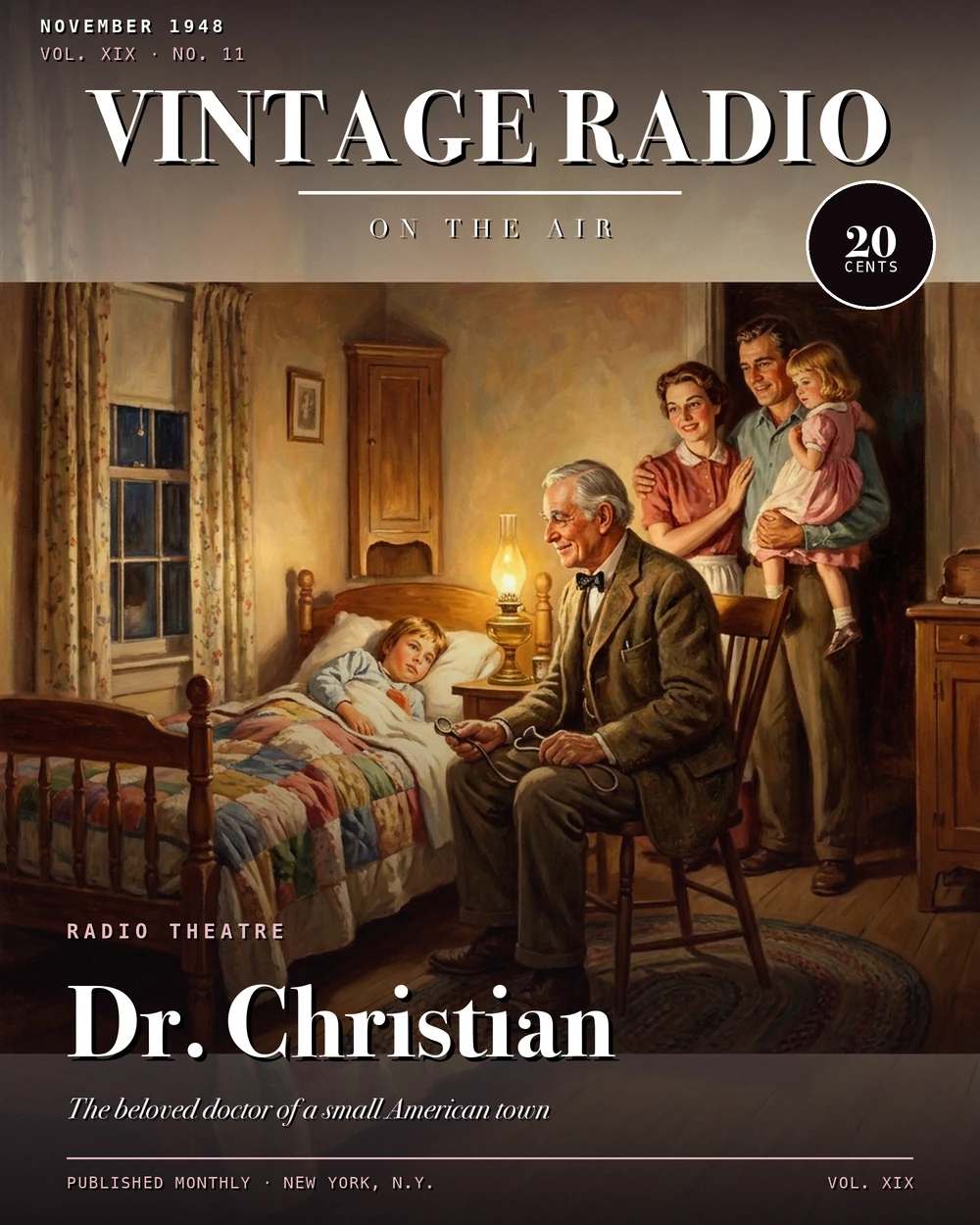
Dr. Christian
How a Movie Doctor Became a Radio Institution
The idea for Dr. Christian started with a film credit. In 1936, Danish-born actor Jean Hersholt played Dr. John Luke in The Country Doctor, a thinly veiled account of the real physician who delivered the Dionne quintuplets. Hersholt received sixth billing — beneath the five babies themselves — but the role connected with audiences in a way his previous work hadn't. He'd been a reliable character actor since his silent-film days, playing the villainous Marcus Schouler in Erich von Stroheim's Greed in 1924 and showing up in eleven MGM productions in 1932 alone, including Grand Hotel, which won the Academy Award for Best Picture. But the gentle country doctor was something different. Hersholt wanted to keep playing that character on radio. The real Dr. Dafoe blocked use of his name, so Hersholt reached for another: Christian — partly for its biblical resonance, partly because it carried deep roots in his native Denmark, and partly because it worked naturally with his Scandinavian accent. He also had Hans Christian Andersen in mind, a writer he admired deeply enough that he would eventually translate more than 160 of Andersen's fairy tales into English.
The show debuted on CBS on November 7, 1937, billed as The Vaseline Program, with Chesebrough Manufacturing footing the bill. Hersholt played Dr. Paul Christian, a kindly doctor-philosopher in the small town of River's End — corn country, universal America, the kind of place with a State Street, a church, a school, a bank, and a block where the best people lived. On the fringes sat farms, a dairy, a lumber yard, and an awning works. Dr. Christian himself lived in a white house at the corner of River Road and State Street, where the side door led directly into the waiting room. The show ran 30 minutes and opened with theme music called "Rainbow on the River."
Finding Its Footing — and Its Audience
The early going was not easy. The show started slowly, aired Sundays at 2:30, moved to Tuesdays at 10, then to Wednesdays at 10 — a restless schedule that reflected the difficulty of locking in an audience. When it returned to CBS as a Tuesday prime-time program in October 1938, it went up against NBC's Bob Hope, then an emerging star. The numbers were not kind: Hope pulled a 15.4 Hooperating, Dr. Christian a 6.7 — 12th place versus 79th in the season's standings. Moving to Wednesday nights at 10:00 was no immediate remedy either; competing against Kay Kyser's College of Musical Knowledge in November 1939, the show put up an 8.7 to Kyser's 16.7 over two months head-to-head.
The turning point came when producer Dorothy McCann pushed the network and sponsor to shift the broadcast from 10:00 to 8:30 PM Eastern. The switch happened January 3, 1940. The show's Hooperating jumped roughly 60 percent in a single month — from 8.4 in December to 13.4 in January. That move launched Dr. Christian into Wednesday's Top Ten, where it would remain for 14 consecutive seasons. In July 1940, Chesebrough gave Hersholt a guaranteed two-year contract worth $80,000 and ordered 52 new shows per year, effectively allowing him to step back from his film career. Despite competition from NBC's The Great Gildersleeve — which won the 8:30 Wednesday slot five times to Dr. Christian's two between 1946 and 1953 — both shows coexisted in the Top Ten throughout those years. At its peak, the show held an estimated audience of 15 to 20 million listeners. Hollywood insiders tended to attribute the numbers to the midwestern Bible Belt, dismissing the show as slightly hayseed, but the ratings were what they were.
The Scripts the Audience Wrote
The most unusual thing about Dr. Christian wasn't the character or the setting — it was the writing. In January 1942, the producers publicly announced a listener script contest, inviting the audience to submit original scripts and compete for cash prizes. Weekly awards ranged from $150 to $500. The grand prize paid $2,000. Within two weeks of the announcement, CBS had received 17,750 requests for contest rules; original scripts began arriving by the thousands. Newsweek reported that 7,697 scripts were submitted in 1947 alone, and totals sometimes reached 10,000. The contest made The Vaseline Program the only show in radio where the audience wrote the material.
The results were unpredictable. Some episodes leaned into the show's warmhearted brand — romance gone wrong, misguided youth talked back to reason by the doctor's patient counsel, Cupid in a white coat nudging stubborn people toward each other. Others went considerably further afield. One episode featured a mermaid. Another involved a humanlike jalopy named Betsy that fell in love with a black Packard owned by a woman chief of police. The 1947 prize-winning script had Dr. Christian trying to convince an unborn child that earth was worth arriving in. Radio Life noted that listeners complained when episodes veered toward murder, preferring the show stay mellow.
The contest also turned out to be a proving ground for writers who would become significant elsewhere. Rod Serling won a $500 runner-up prize in 1949 for a script called "To Live a Dream," attending the awards broadcast on May 18 of that year, where Jean Hersholt interviewed the winners on air. Earl Hamner Jr. of Cincinnati won a $500 prize at the same ceremony for "All Things Come Home" — it wasn't even his first win in the contest. The two men met for the first time that evening; Serling would later fill the staff radio-writing position at WLW in Cincinnati that Hamner left when he moved on to fiction writing.
The Man Behind the Doctor
Hersholt was born Jean Pierre Carl Buron on July 12, 1886, in Copenhagen, graduated from the Copenhagen Art School, and appeared in two early short films for the Danish studio Nordisk Film in 1906 before emigrating to the United States in 1913. He moved to Hollywood in 1914, started as an extra in William S. Hart Westerns, and worked his way up to character parts. He became an American citizen in 1918.
The character of Dr. Christian absorbed him. By the mid-1940s, it was reported that Hersholt had never missed a broadcast — not one. He once performed from a hospital bed. When he traveled to Denmark in 1945, Claude Rains substituted as a character called Dr. Webb while Hersholt was heard via transatlantic shortwave. Listeners wrote to Hersholt seeking real medical advice, so completely had they folded the actor into the character. He handled those letters carefully, referring writers to actual physicians without stating outright that he was an actor. He eventually began refusing acting roles that would take him outside the Dr. Christian persona.
His life outside the show was equally full. He founded the Motion Picture Relief Fund and served as its president for 18 years, work that helped create the Motion Picture Country House and Hospital in Woodland Hills, California. He served as president of the Academy of Motion Picture Arts and Sciences from 1945 to 1949 and received honorary Academy Awards in 1940 and 1950 for humanitarian and industry services. In 1956, the Academy instituted the Jean Hersholt Humanitarian Award in his name; the first was presented at the 29th Academy Awards ceremony in March 1957. In 1948 he was appointed a Knight of the Danish Order of the Dannebrog, partly in recognition of his Andersen translation work. His six-volume The Complete Andersen, published in 1949, is described by the Hans Christian Andersen Center of the University of Southern Denmark as the standard translation; his collection of Andersen books and materials is now housed in the Library of Congress. He is one of only eleven people with two stars on the Hollywood Walk of Fame — one for motion pictures, one for radio.
The Production Behind the Show
Dorothy McCann — born Dorothy Barstow — produced Dr. Christian throughout its run. She had developed Death Valley Days for creator Ruth Cornwall Woodman before coming to this series, and she began collaborating with Hersholt through the McCann-Erickson advertising agency, which was developing a program for client Chesebrough Manufacturing. She married the agency's Harry McCann in 1939 and eventually became head of its radio department. The strategic move that unlocked the show's long run — shifting to the 8:30 timeslot — was her call.
Directors over the years included Neil Reagan, John Wilkinson, and Florence Ortman. Neil Reagan was the brother of actor and future U.S. President Ronald Reagan. Organ music was provided by Ivan Ditmars, Lew White, or Milton Charles. Art Gilmore served as announcer from 1942 to 1954, following shorter stints by Andre Baruch and Perry King. Nurse Judy Price — the character who answered the office phone in the show's pre-title dialogue, giving the series one of its alternate names, Dr. Christian's Office — was played by Lurene Tuttle from 1937 to 1943 and by Rosemary DeCamp from 1943 to 1954, with Kathleen Fitz, Helen Claire, and Janet Waldo also taking the role at various times.
After the Radio Run
The radio series ended January 6, 1954. Two years later, the character moved to television in a 39-episode syndicated series produced through CBS and distributed by Ziv Television, with Macdonald Carey playing Dr. Mark Christian — Dr. Paul's nephew. Gene Roddenberry, who would later create Star Trek, wrote scripts for that series. Hersholt, by then ill with cancer, appeared in the first episode to pass his practice to his nephew on screen. He died on June 2, 1956, and is interred at Forest Lawn Memorial Park Cemetery in Glendale, California, where his grave is marked with a statue of Klods-Hans, a Hans Christian Andersen character who left home to find his way in the world. Hersholt's final feature film had been Nicholas Ray's Western Run for Cover in 1955, made just before his diagnosis.
The six RKO Dr. Christian feature films — Meet Dr. Christian (1939), The Courageous Dr. Christian (1940), Dr. Christian Meets the Women (1940), Remedy for Riches (1940), Melody for Three (1941), and They Meet Again (1941) — were low-budget B pictures, each running about 65 minutes, produced independently and distributed by RKO to fill a gap left by the end of its Wheeler and Woolsey comedy series. Of the more than 600 episodes aired during the radio series' run, fewer than 180 are known to have survived.